

It’s been a while since you’ve seen an issue of Blueberri Pi land in your inbox, and I want to own that instead of pretending it didn’t happen. I gave myself a summer reset. Actual rest, actual recovery, the kind where I stayed off my laptop more than I stayed on it. What I didn’t do was stop paying attention. I was still reading, still watching what was shifting under the surface of search and content and AI, just not writing about it in real time.
If you’re new here, welcome. Blueberri Pi is where I write about the systems, people, and platforms shaping how content actually works, not just this week’s algorithm update. If you want the fuller picture of what this newsletter is trying to do, I put together a Start Here post that gives you an overview of what
I’m back with a story that landed right in the middle of my break, one that felt too relevant to Blueberri Pi to let pass quietly. It involves Google, recipes, and an experiment that says more about where this is all headed than most of the AI headlines I’ve read this year.

Meet Riley
Riley bought the peaches twice.
The first batch looked perfect at the farmers market, and then they weren’t. Too soft, and by the time she’d tested the filling, photographed the finished cobbler, cleaned the kitchen, and pulled the images up on her laptop, she already knew she’d be doing it all again. So she bought more peaches, adjusted the cornstarch, changed the baking time, and shot it a second time. Then came the actual writing. She wrrote the ingredients, instructions, timing, substitutions, storage tips, the FAQ section nobody reads until they need it, alt text, metadata, and schema. She edited the photos, uploaded everything, formatted the post, and hit publish.

That was four years ago.
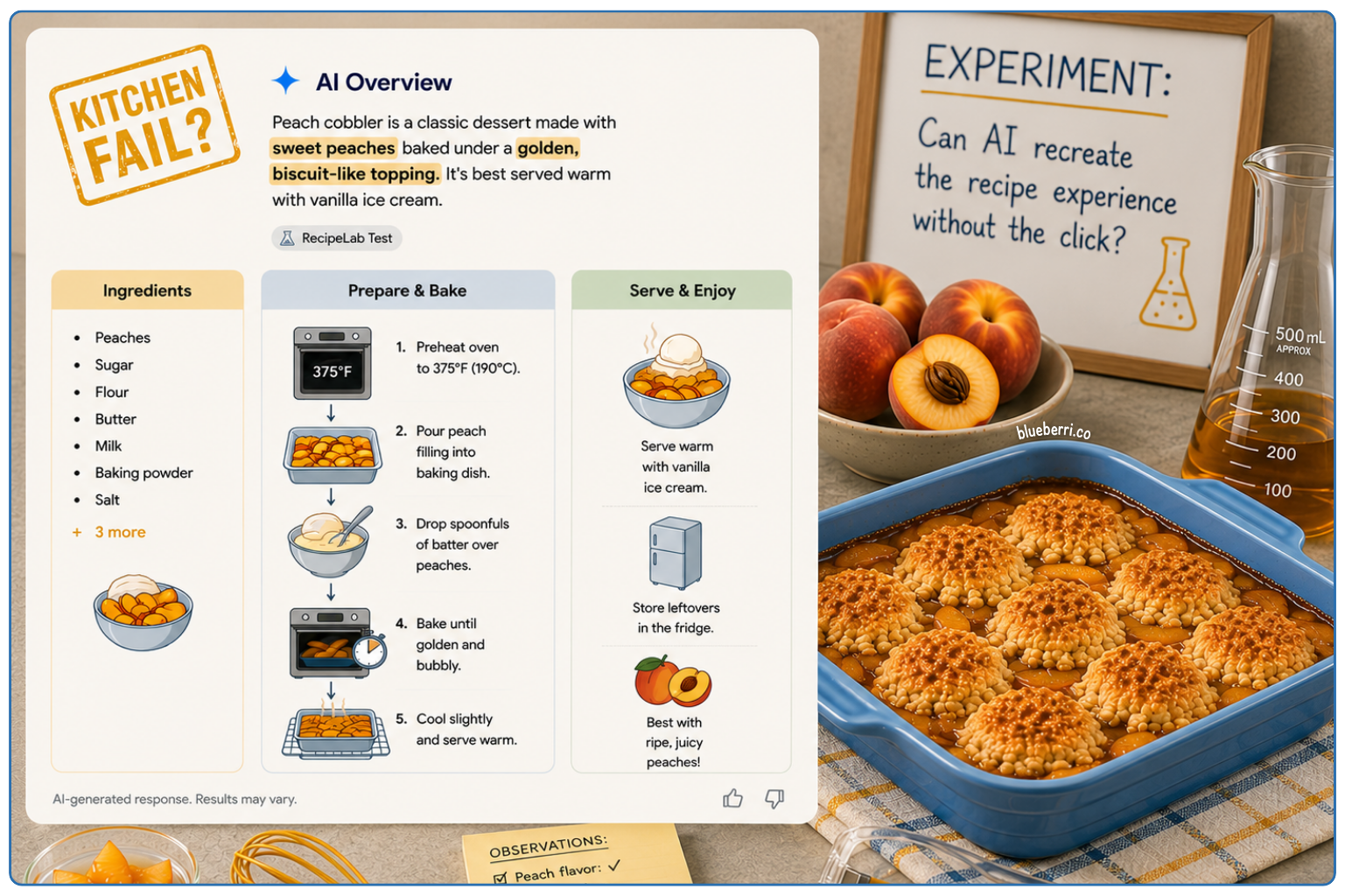
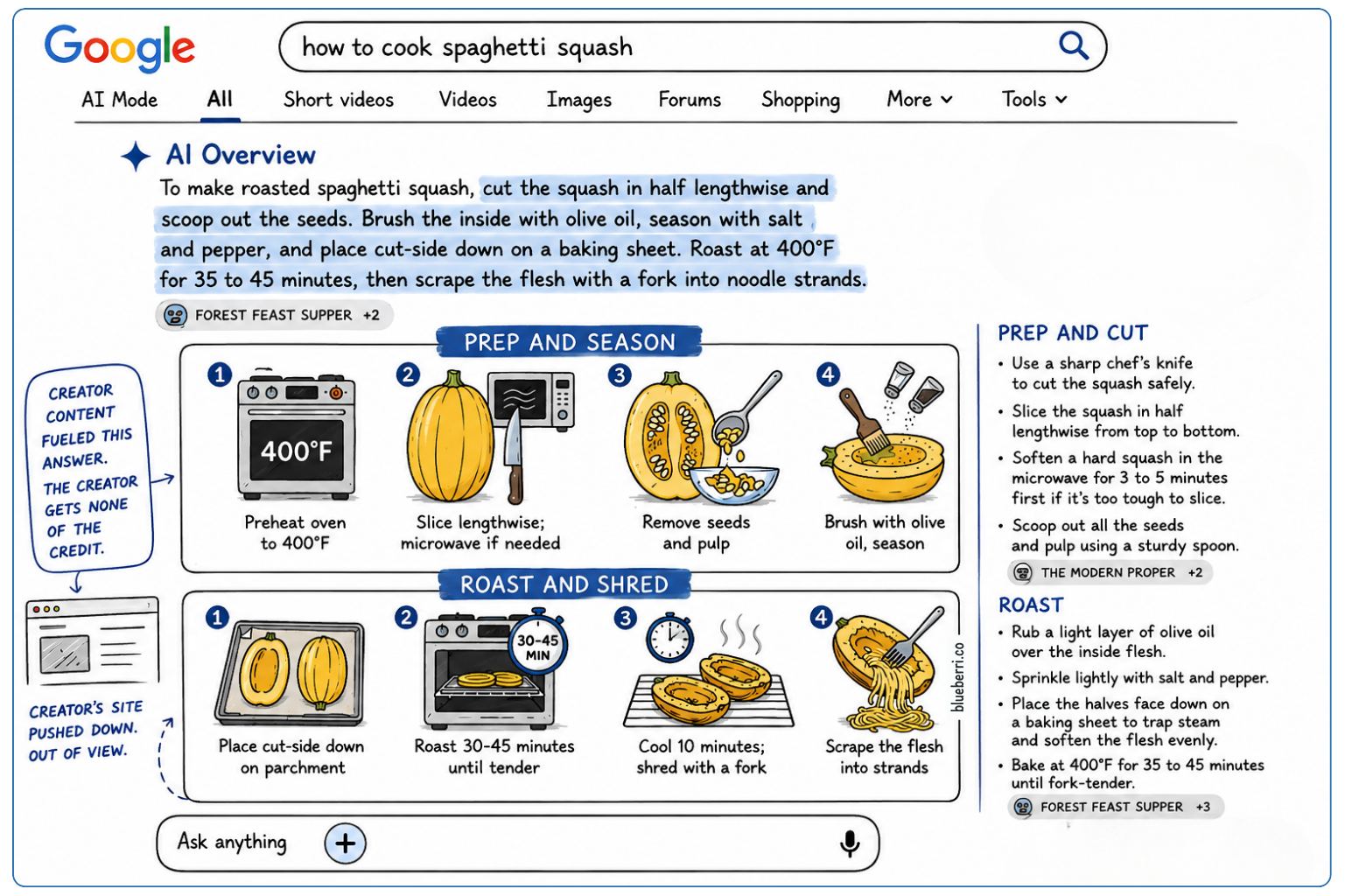
Last week, I was surprised to see that Google tested AI-generated images inside AI Overviews for recipe searches. There were no links to a creator’s step-by-step photography. AI-generated images showing the cooking process, built without a kitchen, a camera, or a Riley anywhere in sight. I didn’t even know an experiment had begun, to be honest.
And in the same stealth fashion, Google ended the experiment, calling it a small test. Right. Technically, that means the feature is gone. For now. I don’t think the interesting part of this story is that it ended. I think it’s what Google thought was possible in the first place, especially the same week Google kept expanding AI Overviews more aggressively, pushing traditional links even farther down the page.
The internet used to need the page
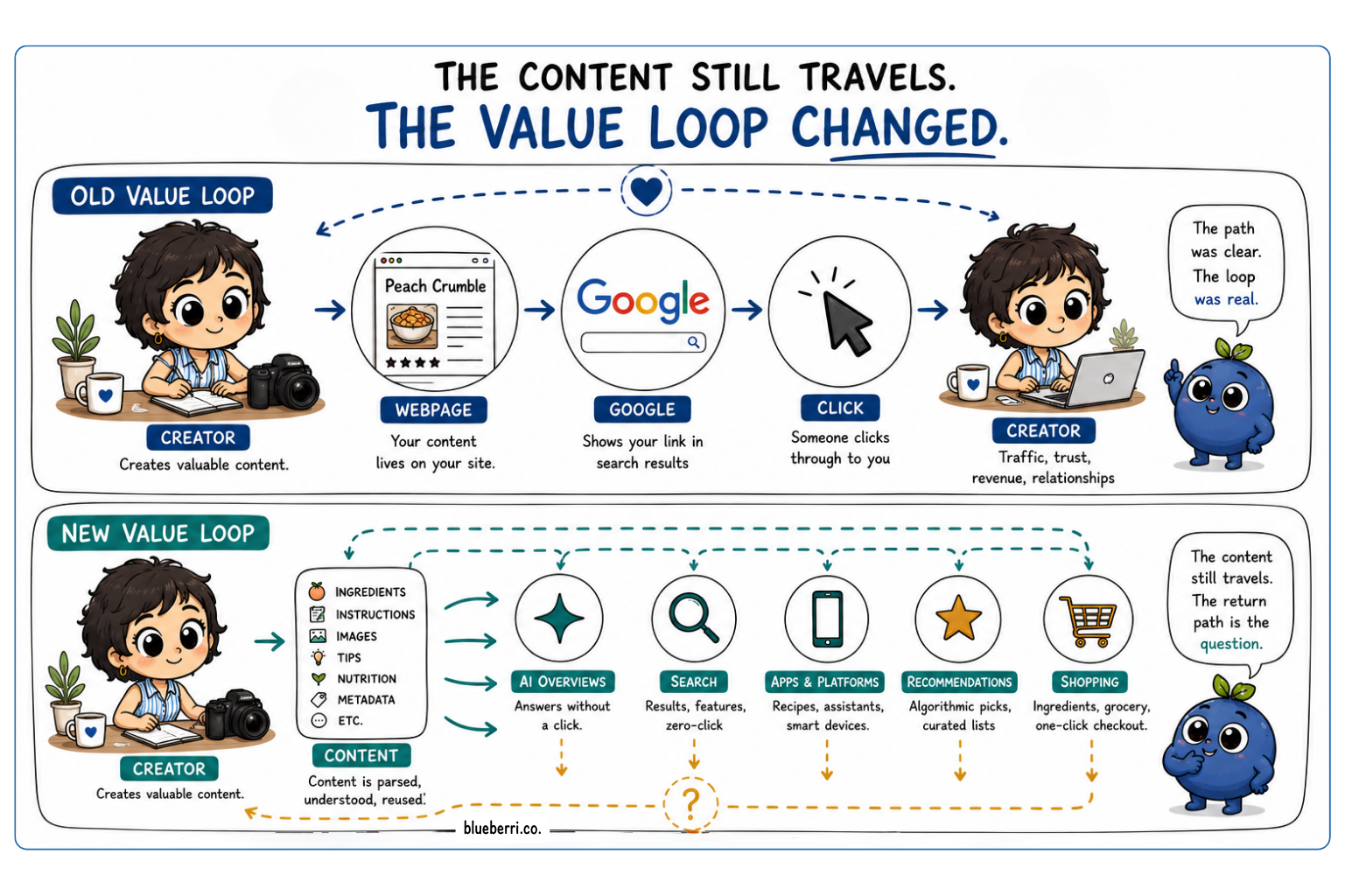
The process used to be so simple. A blogger created a recipe and Google helped someone find it. That person clicked, maybe saw an ad, maybe joined an email list, maybe came back the following week. The system was never perfect, but there was a recognizable path between creating value and receiving some of it back. That path is changing. AI systems can pull information from across the web to build an answer before anyone reaches the original source. And now we’re starting to see what that looks like beyond text.
If we’re really gonna get technical (which I love to do) a recipe was never just a title and a list of ingredients. It’s a dense package of structured knowledge: ingredient relationships, quantities, sequence, timing, temperature, technique, substitutions, dietary information, images, video, and years of small decisions that add up to expertise. Most of that sits invisibly inside what looks, from the outside, like one ordinary webpage. Your content isn’t just something people read. It’s something machines can now interpret and act on.
This is bigger than traffic
We all know where this conversation usually goes next. Traffic. Will AI Overviews decrease clicks even more, and by how much? Will Google send fewer people to recipe sites? A creator’s business runs on ad revenue. It’s your bread and butter, but focusing only on traffic makes it easy to miss the bigger shift, which is that the unit of value itself is changing.
Owned platforms are extremely valuable but creators treat the webpage as the only asset. You create the post, rank the post, drive traffic to the post, monetize the traffic. But the webpage was always just one container for the thing that actually mattered underneath it, which is the content itself. The systems around us are getting much better at separating the two.
Your instructions can become an answer somewhere else. Your ingredient list can become a shopping list. Your expertise can inform a recommendation you never see. Your video can become source material for a format you didn’t make. Your recipe can be useful in a place you never published it. That opens up real opportunity. It also raises the uncomfortable question of if your content can travel without your webpage, what travels with it. Your name, your authority, your attribution, your rights, your business model. Or just the information, stripped of everything that took years to build.

And then, something else happened
It’s been a busy few weeks.
The Wall Street Journal reported on something called creator-first answer engine optimization. Yes, we have apparently reached the point in the internet’s evolution where AEO needed another modifier attached to it. 😅
Okay, so we now have this slightly absurd new acronym, but stay with me. This means that brands are starting to study which creator content shows up inside AI-generated answers, so they can understand, and potentially influence, what those systems recommend.
I hate the doom narrative, and this isn’t supposed to be one. Creator content isn’t becoming less valuable just because AI can answer questions on its own, but more valuable. The problem is that the mechanisms for capturing that value haven’t caught up yet. Creators are still largely trained to measure success through pageviews, followers, likes, and reach. Meanwhile, companies are starting to look at that same creator content as input into recommendation systems. Those are two very different ways of understanding the same asset, and right now most creators are only equipped to think in one of them.
You don’t need another platform strategy
You need a content infrastructure strategy, and those are not the same thing.
A platform strategy asks what to post on Instagram, whether to make more video, how to optimize for Google, whether TikTok is worth the time, and what on earth to do about AI. A content infrastructure strategy asks what have I already created, how is it structured, where can it travel, and how does value make its way back to my business when it does.
That second question is a lot more substantial, because platforms will keep changing. Google will run another experiment. (Keep your eyes out for that!) AI systems will introduce new interfaces. Social platforms will shift their distribution again. New devices will show up that nobody’s fully planned for. And creators will keep being told they need to build something new for each one.
Creating something new for every platform isn’t sustainable and definitely not necessary.
Content infrastructure is everything behind the page that allows your content to keep working beyond the place it was originally published.

Your archive may be more valuable than you think
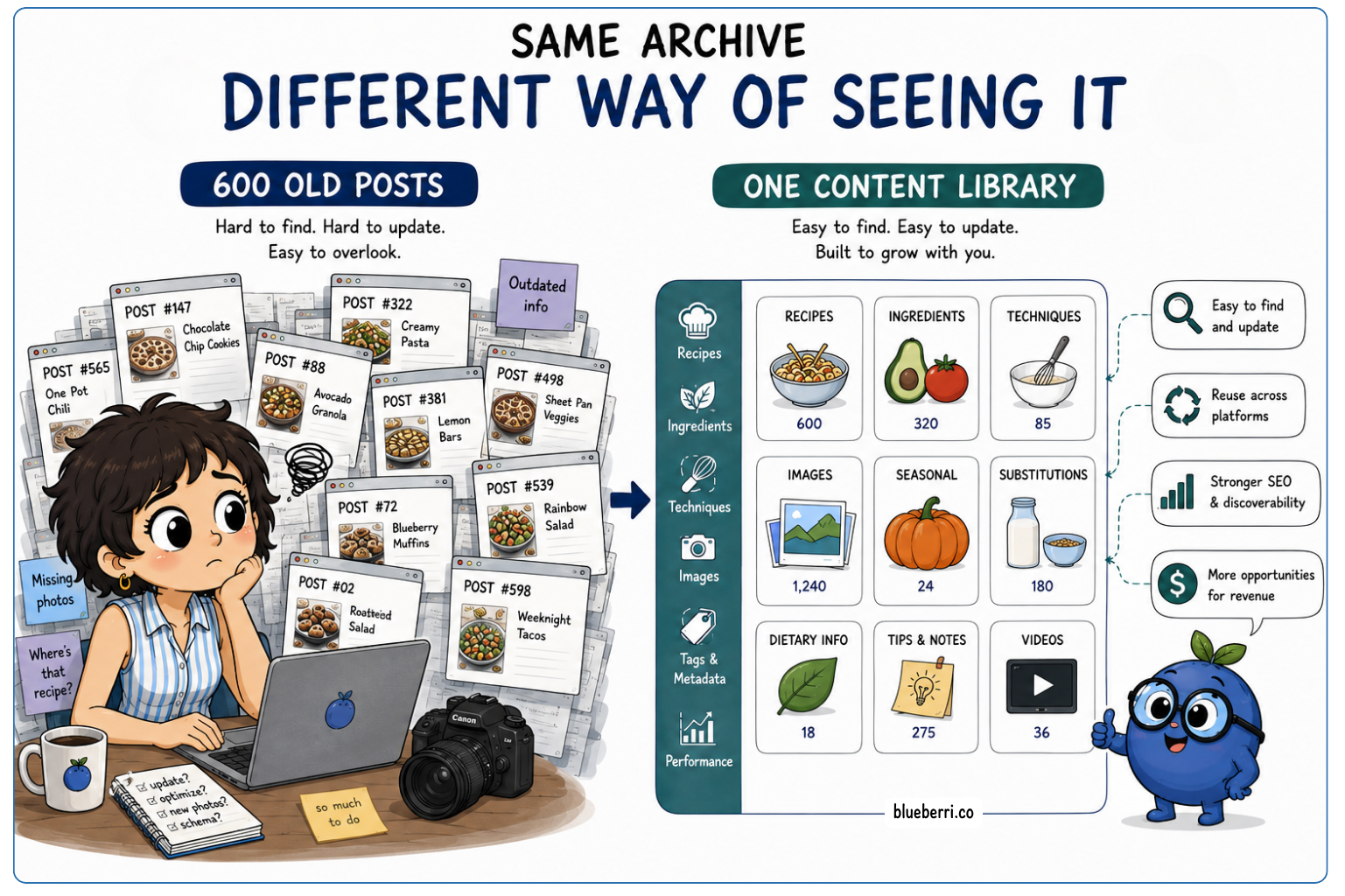
Picture Riley’s site a little differently. Not as 600 old blog posts, but as a structured library holding 600 tested recipes, thousands of ingredient relationships, years of seasonal expertise, thousands of original photographs, hundreds of cooking techniques, dietary adaptations, substitution knowledge, video, stories, and audience insight built up over years of trial and error.
That’s a very different sentence than “I have a bunch of old blog posts I need to update.” One sounds like maintenance debt and the other sounds like intellectual property.
That’s the reframe I want creators sitting with. The people best prepared for whatever comes next probably won’t be the ones publishing the most. They’ll be the ones who actually understand what they already own, how it’s structured, where it can be reused, where it’s already showing up, and increasingly, under what conditions someone, or something, gets to use it.
Don’t ignore the signal
I have no idea whether Google brings AI-generated recipe images back. Maybe it does, maybe it doesn’t, and honestly, that’s not really the point.
The experiment showed us the internet is moving from systems built primarily to find content toward systems that can interpret, assemble, and present content on their own. That changes what it means to create for the internet in the first place, and it makes something I’ve believed for a while now feel a lot more urgent: creators need to stop thinking of their archive as a pile of webpages. It’s a library of structured knowledge, and the more capable machines get at understanding that knowledge, the more important it becomes for creators to understand it too.
Riley shouldn’t have to buy the peaches twice just so the internet has something new to consume next Tuesday. She already did the hard part. She created something valuable. The real question now is whether she’s built the infrastructure to make sure that value keeps working for her, and not just for whatever comes looking for it next.
Start smaller than you think
If “build content infrastructure” sounds like I just handed you another enormous project, I didn’t.
Start with one piece of content you already know has value.
Look behind the webpage. Can you clearly identify the recipe, ingredients, instructions, images, video, substitutions, techniques, metadata, and expertise inside it?
Do you know where those pieces live? Can you update them without hunting through five systems? Could you reuse them somewhere else without rebuilding the whole thing?
That’s content infrastructure work.
You don’t have to restructure 600 posts tomorrow. Just start seeing what you’ve already created differently.
Until next time,
