Last week, I talked about the shift happening in how content gets discovered.
We’re moving from a world where visibility depended almost entirely on search, to one where systems now sit between you and your audience. People aren’t just searching anymore, they’re asking. And those systems are responsible for finding, interpreting, and delivering content in response.
This isn’t theoretical. AI tools are quickly becoming the starting point for discovery, not just an alternative to search. Instead of typing keywords into Google, users are asking full questions and expecting complete answers.
This week, I want to slow that down and make something clearer. Your content isn’t being understood.
Meet Leah
Leah’s based in San Antonio, filming out of her teal kitchen, the kind that feels warm even before the oven’s on. She didn’t think there was any problem with her content. Her recipes are solid. Her videos are clean. She’s consistent. Thoughtful. The kind of creator people should find.
This week, she’s filming a pistachio chocolate cake. Ring light on. Phone angled down.
Check. Check.
She’s smiling as she sprinkles crushed pistachios over the top, catching that perfect final shot she knows will land on Instagram. She’s done this hundreds of times. She’s what I call a High Output Creator.

But still, later that night, she’s staring at her numbers thinking, Why isn’t this working? That’s where you saw her last week. From the outside, everything looks right, but under the surface, her content is doing what most content does.
It’s being created to be watched…
not to be understood.
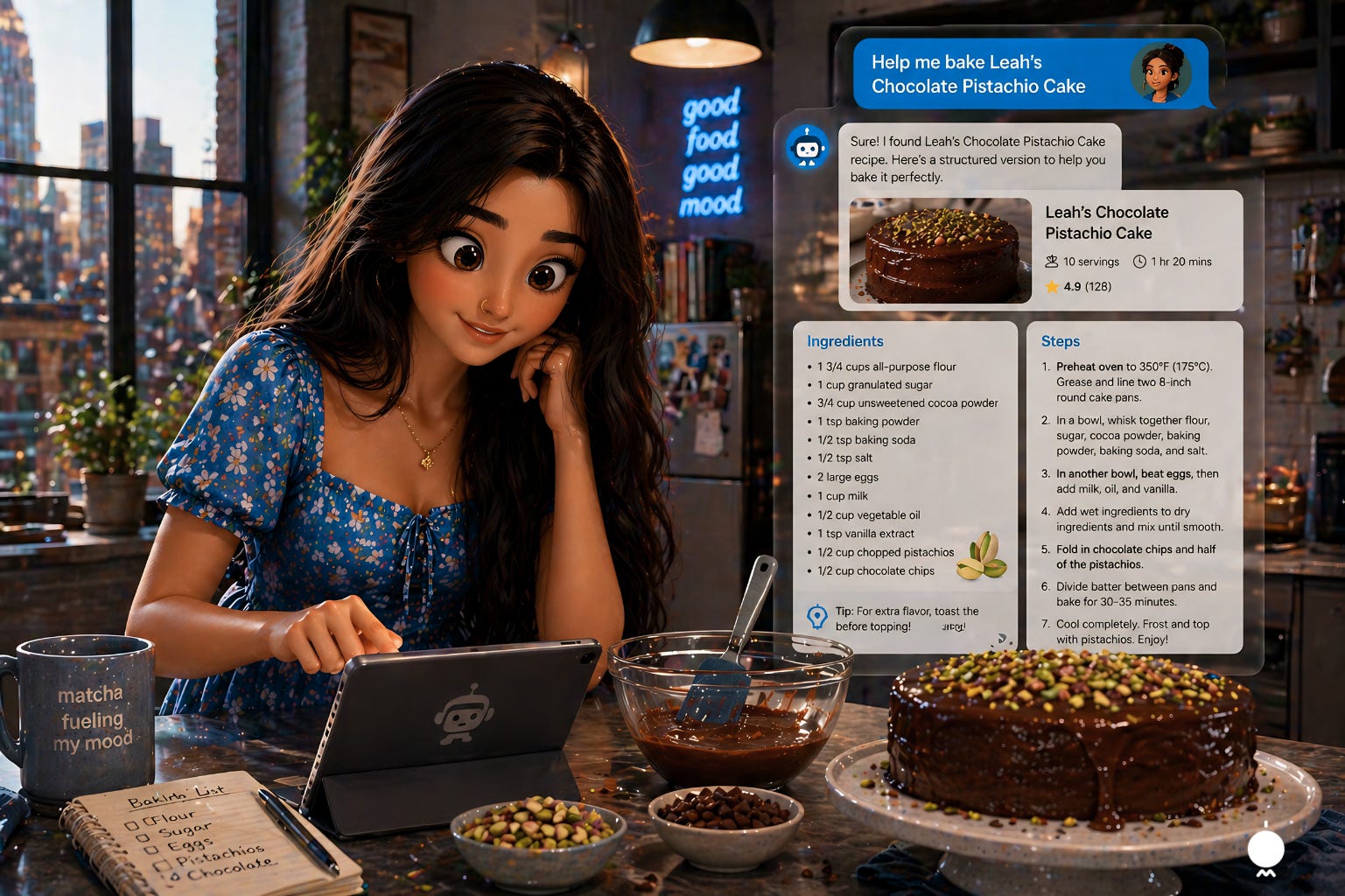
Her ingredients are in a paragraph.
Her steps live inside a story.
Her metadata is inconsistent.
To a person, it feels natural, but to a system, it’s unclear. And right now, systems are the ones deciding what gets seen.
Why “not understood” changes everything
The systems now shaping discovery don’t interpret content the way people do.
They don’t read context, infer meaning, or connect ideas across paragraphs. They rely on structure to make sense of what’s in front of them.
And we’re already seeing the effects of this. As more queries are answered directly by AI systems, click-through rates are declining. In some cases, content is being used without ever being visited.
When that structure isn’t there, things start to break down.
Ingredients get buried in paragraphs instead of being clearly defined. Steps are written as narratives instead of distinct actions. Important context is implied rather than explicitly labeled. Metadata is inconsistent or missing entirely.
To a human reader, this often feels natural, even engaging. To a system, it creates friction.
And that friction makes content harder to surface, harder to adapt, and harder to reuse across the environments where discovery is increasingly happening.
Why more content isn’t fixing it
One of the most consistent patterns I see is how many creators are caught in a loop of producing more, posting more, without seeing the results they expect. There’s almost a fear of stopping. Even for a day. When performance dips, the instinct is to increase output.
But more content doesn’t fix a structure problem. It just scales the inefficiency behind it. That’s why this doesn’t feel like a structure issue. It feels like a visibility issue, or a platform issue, or even a quality issue. But underneath all of that, content is being created for people, but not for the systems now responsible for distributing it.
Where COSE™ actually starts
Last week, I introduced COSE™ as a framework: Create Once, Share Everywhere. But the shift doesn’t start with sharing. It starts with how content is built.
Structure isn’t something you layer on later. It’s the foundation that determines whether your content can move, adapt, and extend beyond a single format or platform.
And that matters even more now, as platforms begin to turn content into action. Tools like ChatGPT and Claude are already integrating with services like Instacart, allowing users to go from recipe discovery to grocery checkout in a single flow.
Without structure, your content can’t participate in that flow.
Without it, everything stays fixed in place. With it, your content becomes something that can be understood, reused, and distributed in ways that weren’t possible before.
A simple way to think about the difference is that most content is created in a linear flow—write, format, publish. Structured content takes a different approach—define, organize, then express.
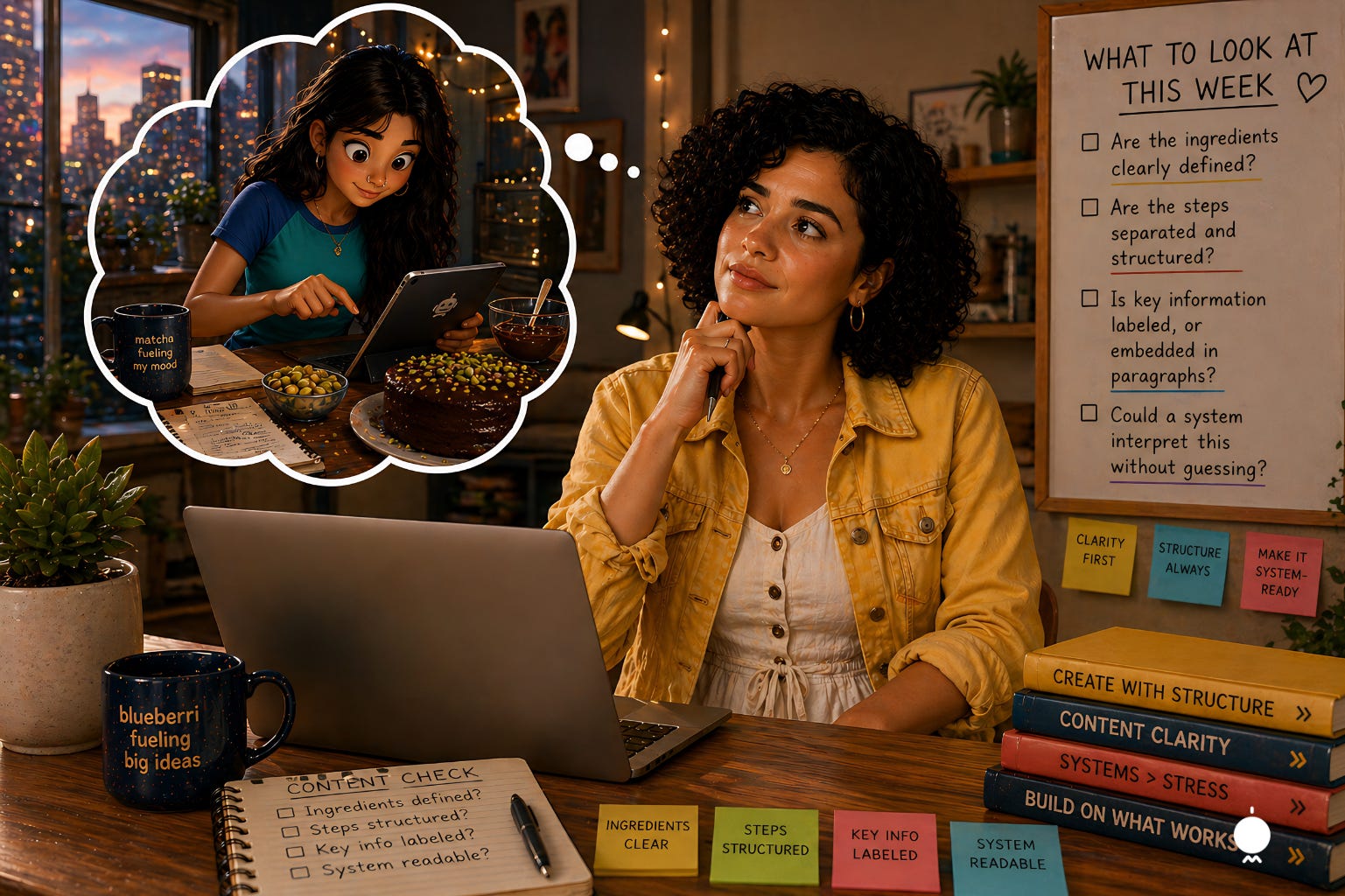
What to look at this week
Take one piece of your content and look at it through this lens.
Are the ingredients clearly defined?
Are the steps separated and structured?
Is key information labeled, or embedded in paragraphs?
Could a system interpret this without guessing?
Those questions will tell you more than any metric right now.
The book is coming together (and you can be part of it)
My favorite part of writing this book is also the hardest. Stepping back and making sure the ideas actually make sense, build in the right order, and are genuinely useful.
The next step is sharing the manuscript with an early reader group. If you join, you’ll get exclusive access to the manuscript before it’s published.
Quick SPOILER: It will have typos. It will have grammar issues.
That’s intentional. This isn’t about a perfect draft. It’s about making sure the ideas land.
Here’s where I need your help:
You’ll have about two weeks to read it
You’ll answer 10–15 questions afterward
And I’m not looking for praise.
I want to know:
Is this helpful?
Does it make sense?
Does it actually move you forward as a creator?
If that sounds like something you’d want to be part of, you can sign up here.
In the next issue, I’ll break this down further and walk through what “Create with Structure” actually looks like in practice and how to start applying it without rebuilding everything from scratch.
We will focus on making sure what you already create works better.
If we haven’t met, I’m Sandie.
Blueberri Pi is where I break down how food creators and content teams can make their work more structured, more discoverable, and more sustainable.
See you next Friday.