

Have you ever wondered why recipes look the way they do?
Most recipes follow a familiar pattern. There’s usually a title, a list of ingredients, a set of instructions, a serving size, and sometimes notes or substitutions. Whether you’re reading a handwritten recipe card from a grandparent or browsing a modern food blog, the format feels so natural that most of us never stop to question it.
But that structure didn’t happen by accident.
Someone, somewhere, decided that ingredients should be separated from instructions. Measurements should be listed before cooking begins. Steps should follow a logical order. Over time, those conventions became expectations. And because they became expectations, recipes became easier to read, easier to share, and easier to reproduce.
Before anyone talked about metadata, content models, or structured content, people were already organizing information.
Modern content systems didn't invent structure. They inherited it.
Humans have always organized information
One of the biggest misconceptions about structured content is that it’s a technology concept. It’s a human concept.
Libraries use structure. Grocery stores use structure. Maps use structure. Museums use structure. Even your kitchen probably uses structure. There’s a reason spices aren’t mixed randomly with canned goods and baking supplies aren’t stored in six different rooms.
Structure reduces effort. It helps people find things faster. It helps information make sense. It helps knowledge survive beyond the person who created it.
When librarians created classification systems, they weren’t trying to optimize for search engines. They were trying to solve a human problem. As collections grew larger, finding information became harder. Structure was the solution.
The internet didn’t invent this challenge; it just made it bigger.
What changed when information became digital?
The internet dramatically increased the amount of information being created and shared. Suddenly, content wasn’t living in a single book, filing cabinet, or library shelf. It was spread across websites, apps, databases, search engines, social platforms, and devices.
The old challenge remained. People still needed to find things. The difference was scale.
A cookbook might contain a few hundred recipes. A recipe platform might contain hundreds of thousands. A library might catalog millions of books. Search engines now organize billions of pages. At that scale, structure becomes less of a convenience and more of a necessity.
That’s why so many conversations today involve metadata, taxonomies, schemas, content models, and structured content. These aren’t entirely new ideas. They’re modern solutions to a very old problem.
How do we organize information so people can actually use it?
The recipe card and the CMS
A few years ago, someone asked me what structured content actually is. I could have given a technical answer. Instead, I showed them a recipe card. A recipe card is surprisingly close to a content model.
It has a title, ingredients, instructions, preparation time, serving size (yield), and notes.
Each piece of information has a purpose. Each piece belongs somewhere specific. If someone wrote the instructions where the ingredients should go, the recipe would still contain the same information, but it would become much harder to use.
Modern content management systems work the same way.
Imagine entering a recipe into a CMS. Instead of pasting everything into one giant text box, the system gives you separate fields for the recipe title, ingredients, instructions, cooking time, nutrition information, cuisine type, and categories. Each piece of information is stored independently.
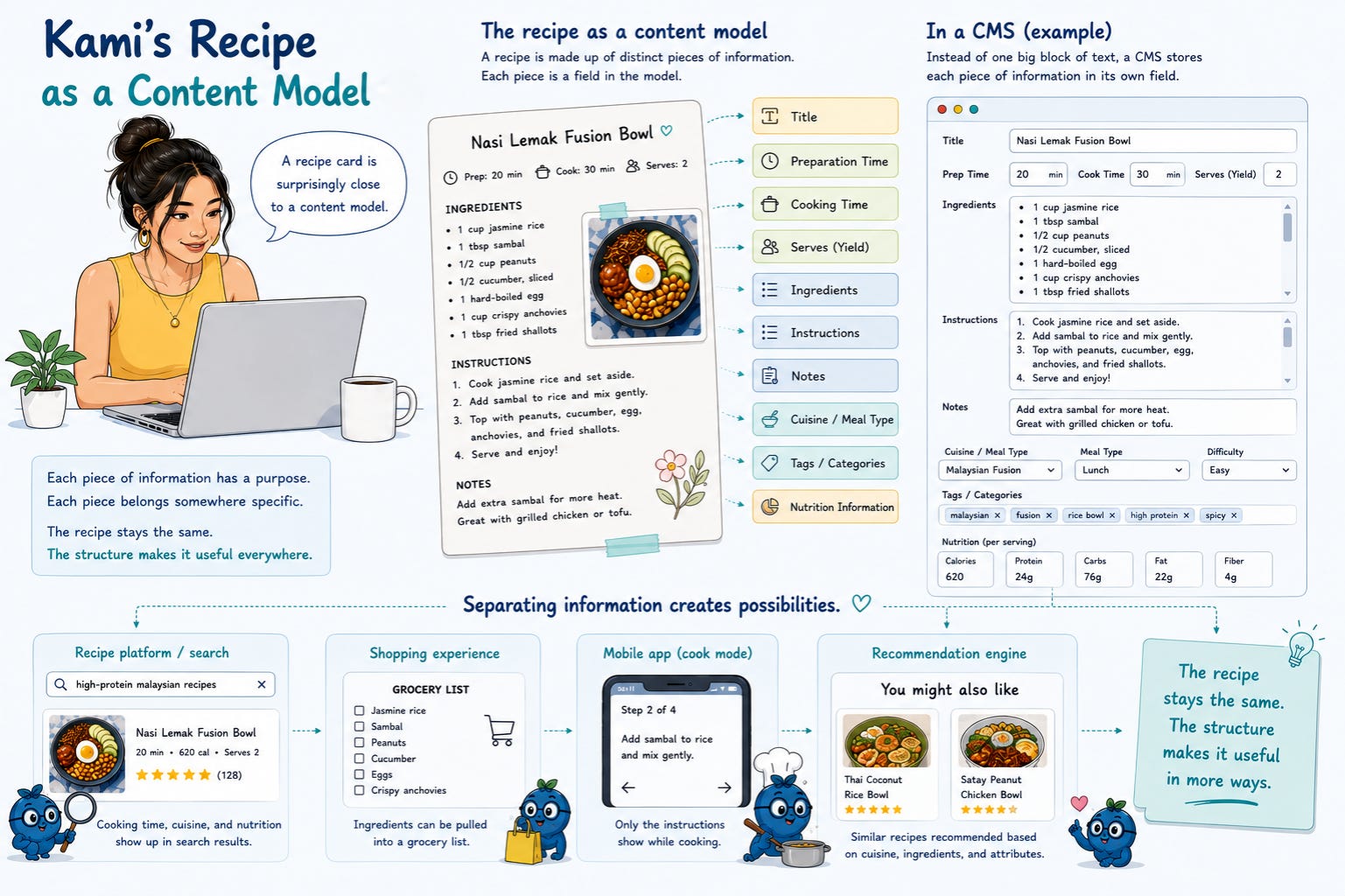
At first, that can feel like extra work. But separating the information creates possibilities. A recipe platform can display cooking time in search results. A shopping experience can pull ingredients into a grocery list. A mobile app can show only the instructions while someone is cooking. A recommendation engine can suggest similar recipes based on cuisine or dietary preferences.
None of those experiences are possible if everything is trapped inside a single block of text. The recipe itself doesn’t change. The structure does.
That’s why content management systems aren’t really managing pages. They’re managing information. The more clearly information is organized, the easier it becomes to find, retrieve, reuse, and adapt for different experiences.
That’s also why structured content often feels invisible when it’s working well. The structure fades into the background, allowing the information itself to take center stage.
Structured content vs. structured data
Structured content organizes information.
Structured data describes information.
People often use the terms interchangeably because they’re closely related. Structured data is usually built from structured content. If information isn’t organized first, it’s much harder to describe consistently later.
That’s why content professionals, developers, SEO specialists, and platform teams sometimes use different terminology. They’re often talking about different layers of the same system.
Why everyone is talking about structure again
If you’ve been paying attention to content and AI conversations lately, you’ve probably noticed that structured content keeps coming up.
Adobe has been discussing structured content as a foundation for automation and personalization. Content operations professionals talk about modular content. Technology companies are investing heavily in content systems that make information easier to manage, retrieve, and reuse.
At first glance, it might seem like AI created this renewed interest. I don’t think that’s what happened. I think AI reminded us why structure mattered in the first place.
The more information moves through systems, the more important it becomes for that information to retain its meaning. Search engines, recommendation engines, shopping experiences, recipe platforms, voice assistants, and AI tools all need ways to understand what information represents.
The challenge isn’t new. What’s new is the number of systems interacting with content. And that number is growing quickly.
When structure becomes a business advantage
For a while, creators could think about content as a destination. Someone visited a website. Read an article. Made a recipe. Clicked an ad. The experience began and ended on a webpage.
That model is starting to change. Recent reporting has highlighted growing concerns among food bloggers as AI-powered search experiences provide recipe answers directly within search results. Whether creators like this shift or not, it reveals something important.
Content is being separated from the place where it was originally published. Information is traveling.
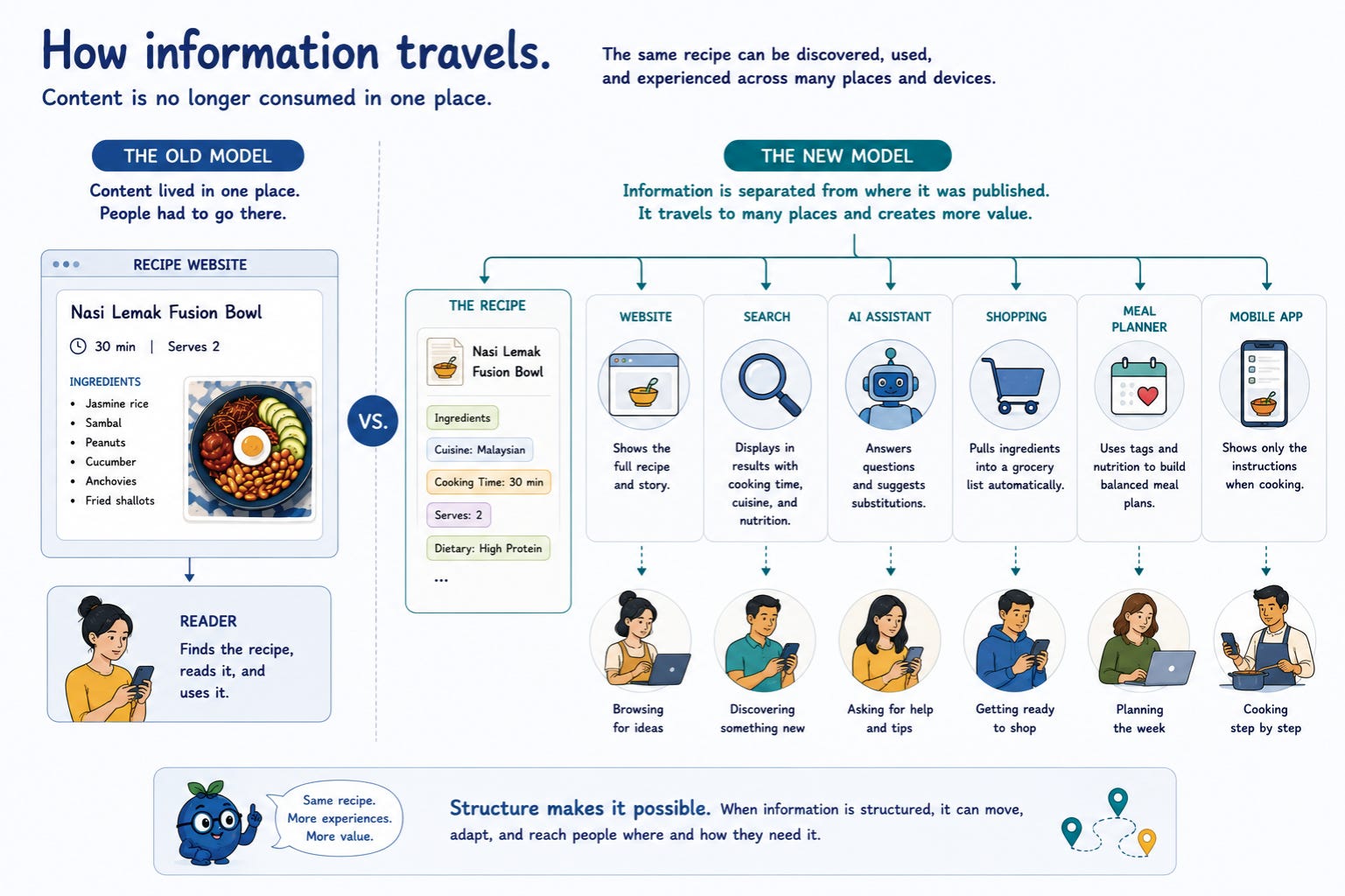
The question is whether it can travel well.
Ann Rockley, one of the pioneers of intelligent content, described intelligent content as content that is discoverable, reusable, reconfigurable, and adaptable. She argued that structured, semantically rich content becomes easier to find, personalize, deliver, and reuse across different channels and experiences.
Those ideas were originally developed for enterprise content systems, but they’re becoming more relevant to creators.
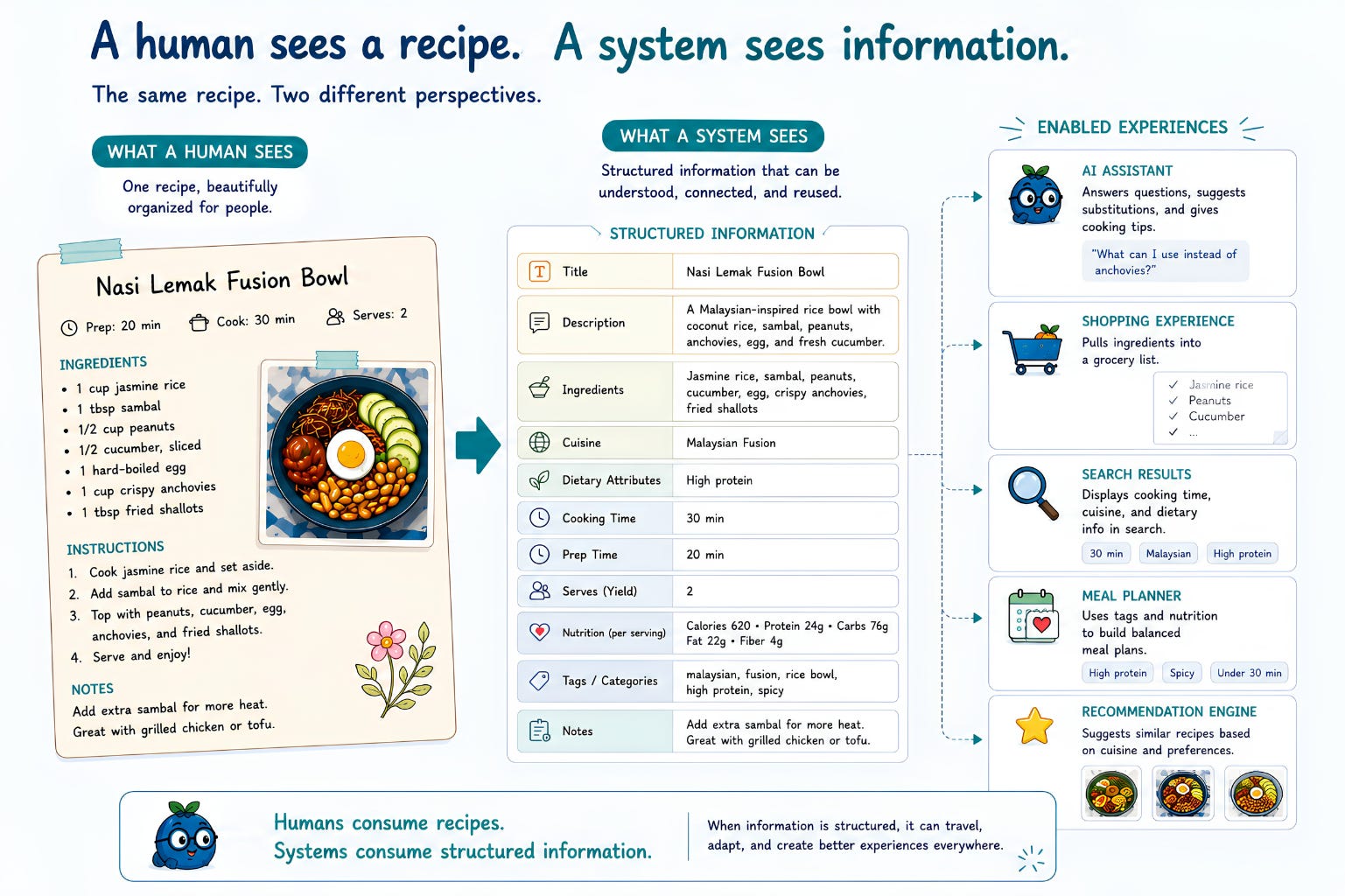
If someone asks an AI assistant for a high-protein Malaysian-inspired dinner, or a personalized recipe recommendation based on dietary preferences, the system is looking for information it can understand.
The easier your content is to understand, the easier it becomes to retrieve, connect, personalize, recommend, and reuse. That doesn’t guarantee revenue, but it does create opportunity.
A recipe that more systems can understand can potentially appear in more places. It may power search experiences, shopping integrations, recipe collections, recommendation engines, personalized meal planning, future AI experiences, and opportunities that don’t exist yet.
A human sees a recipe. A system sees ingredients, nutrition, dietary attributes, cuisine types, cooking times, techniques, and relationships.
That’s one reason I believe structure matters more today than it did five years ago. Personalization is becoming normal, AI is becoming a discovery tool, and content moves through systems before it reaches people. As those systems become part of how information is discovered and delivered, the ability for content to retain its meaning across different experiences becomes more important.
The creators who benefit most from future platforms will be the ones whose content can travel the farthest while retaining its meaning.
Meet Kami

Kami is a food creator in the Bay Area who specializes in Malaysian fusion cooking. Some of her recipes are inspired by dishes she grew up eating, while others blend traditional Malaysian flavors with ingredients and techniques she discovered in California. On any given week, she might be filming a recipe video, testing a new dish, writing a newsletter, or responding to questions from readers who have made her recipes at home.
Like many creators, Kami didn’t spend much time thinking about structure. She thought about whether the recipe worked, whether the instructions were clear, and whether the finished dish looked delicious. If someone could successfully recreate the recipe in their own kitchen, she considered it a success.
For a long time, that was enough.
The recipe started showing up everywhere
One day, Kami noticed that the same recipe was appearing in far more places than she originally intended. It lived on her website, but pieces of it were also showing up in newsletters, social media posts, recipe collections, search results, and cooking apps.
Readers were saving screenshots of ingredient lists. Search engines were displaying cooking times and ratings directly in results. AI tools were summarizing recipes when users asked questions. The recipe was no longer just a webpage. It had become information moving through multiple systems.
That’s when Kami started seeing her content differently. The ingredients weren’t just ingredients. The cooking time wasn’t just a helpful detail. The instructions weren’t simply a block of text. Each piece of information served a purpose and could be reused independently of the recipe itself.
The structure in the recipe had become visible.
For most of human history, structure has helped people find information, share knowledge, and make sense of complexity. Today, those same principles help information move through search engines, recommendation systems, shopping experiences, and AI tools. The technology may be new, but the underlying idea isn’t. The recipe wasn’t structured because a machine needed it; it was structured because people did. The machines just arrived later, and as more systems begin interacting with content, that old lesson feels surprisingly relevant again.
Support Blueberri Pi
Blueberri Pi will always include free issues because I believe these conversations should be accessible to anyone interested in content, technology, and the future of publishing.
For readers who want to go deeper, paid subscriptions help support the research, writing, podcast production, and educational resources that make this publication possible.
Paid subscribers receive:
Complimentary 30-minute Q&A sessions
Early access to select resources and frameworks
Subscriber-only strategy discussions
Behind-the-scenes insights from the development of ARC™, MAP™, and COSE™
Full access to the Blueberri Podcast, where I explore content engineering, structured content, metadata, AI, and the systems shaping the future of publishing
The newsletter is where I share ideas. The podcast is where I unpack them in more depth.
If you’d like to join those conversations, consider becoming a paid subscriber.
One thing to think about this week
The next time you follow a recipe, walk through a grocery store, browse a library, or search for something online, pay attention to the structure hiding in plain sight.
You might discover that some of our most important systems aren’t built on entirely new ideas.
They’re built on old ones that still work.
See you next Friday.
— Sandie