

I attended a webinar about AI. It was one of those sessions where I found myself taking notes almost as quickly as the presenter was speaking. I was picking up everything they were putting down. Some of the material was familiar because I’ve spent years working with engineers and product teams. I speak ‘engineer’. Some of what was discussed was new. Most of it was useful. As I listened, though, I found myself paying attention to something other than the slides.
Certain words kept appearing throughout the presentation. The presenter moved through them naturally, assuming the audience understood what they meant. Maybe they did. AI has become so ingrained in everyday conversation that it’s easy to forget how quickly the language around it has become normalized. Still, I couldn’t help wondering if everyone listening actually knew what a token was or why they should care.
I thought about my own relationship with AI that started in a very different place than it does for most people today. My first experience with a machine learning model wasn’t ChatGPT. It wasn’t Claude. It wasn’t even the early versions of generative AI that dominate headlines now.
It was BERT.
Before ChatGPT, there was BERT
Back in 2019, I was leading the Content Engineering team at SideChef. We were building shopping experiences around recipe content, and the problems we were solving looked very different from the AI conversations happening today. Nobody was debating whether machines would replace writers. Nobody was creating AI agents. Instead, we were trying to understand how machines interpret information and why they so often got it wrong.
One of the questions we ran into all the time sounded simple. How does a system know that canned tuna and tuna in water are describing essentially the same thing?
A human understands that connection immediately. A machine doesn’t.
Multiply that problem across thousands of ingredients and hundreds of thousands of grocery products and you begin to see the challenge.
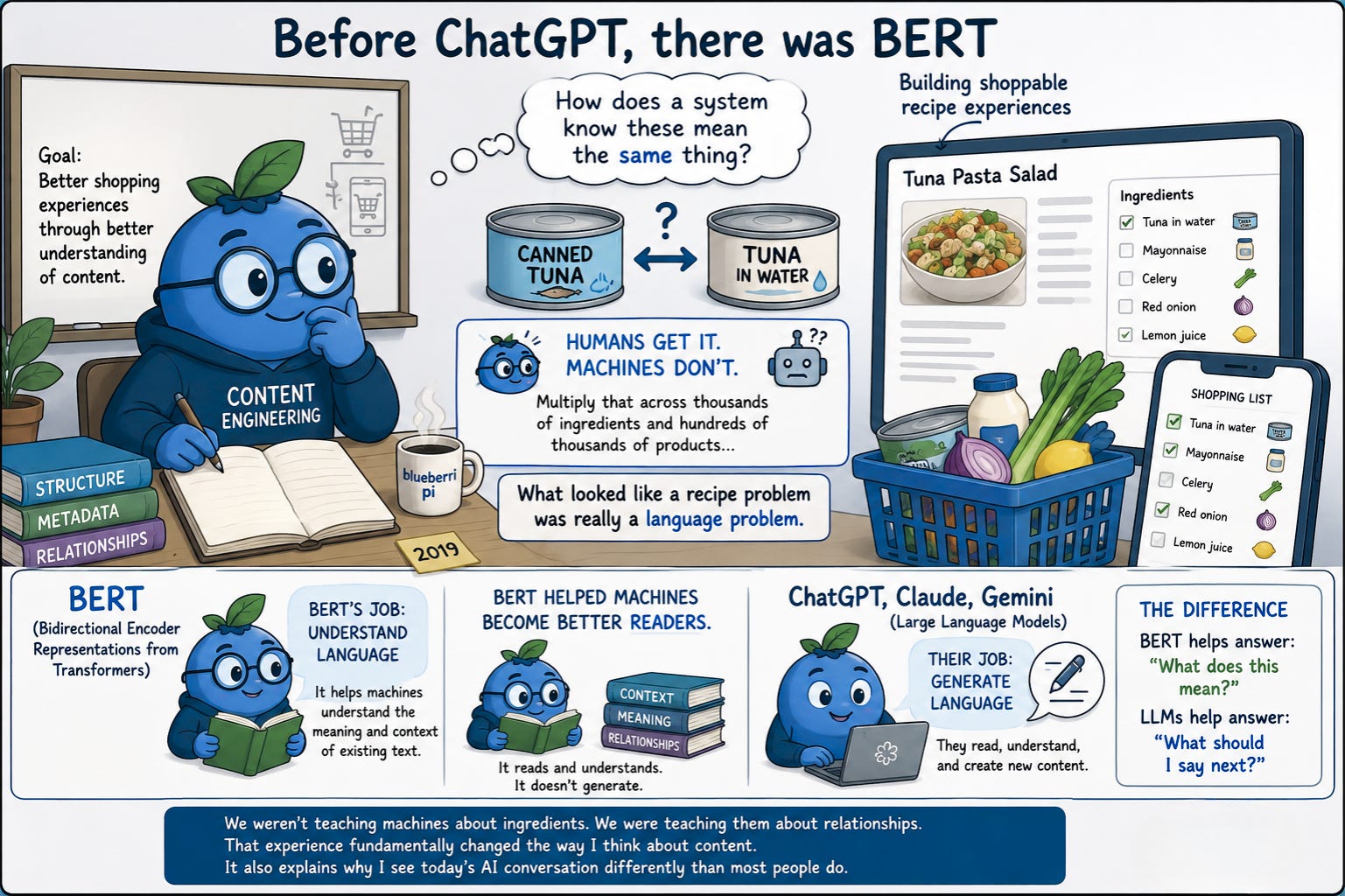
Looking back, I realize we weren’t actually teaching machines about ingredients. We were teaching them about relationships. We were defining how information connected to other information. We were creating structure that allowed systems to interpret meaning more accurately. BERT represented a major step forward because it helped machines understand language in context.
BERT was a machine learning model introduced by Google that helped computers better understand the meaning and context of language.
BERT stands for Bidirectional Encoder Representations from Transformers.
Unlike ChatGPT, Claude, and Gemini, which are designed to generate answers and create new content, BERT’s primary job was understanding what existing text meant. In many ways, BERT helped machines become better readers, while today’s large language models are designed to be both readers and writers.
That experience fundamentally changed the way I think about content.
In many ways, it also explains why I see today’s AI conversation differently than most people do.
From the Blueberri Podcast
While writing this issue, I kept thinking about a conversation I had with myself while recording the very first episode of The Blueberri Podcast.
The episode starts with a simple question.
How did we get here?
Not just to ChatGPT, Claude, and Gemini, but to a world where content, search, recommendation engines, grocery apps, voice assistants, and AI systems all rely on structured information to function.
In the trailer, I share why I started the podcast and what listeners can expect. We’ll talk about content strategy, structured content, creator ecosystems, publishing systems, and the invisible infrastructure that shapes how information moves through modern platforms.
If you’ve ever found yourself exc ited by the systems behind the content, you’re probably going to enjoy what’s coming.
The Conversations That Didn't Fit in a Blog Post

I’ve wanted to create an audio-only podcast for a while.
The first full episode launches Monday.
Why do they call it a token?
The name actually makes more sense than it first appears.
A token is simply a unit of language that an AI system can process.
Depending on the model, a token might be a whole word, part of a word, punctuation, or even a space. When you type a question into ChatGPT, Claude, or Gemini, the system breaks your request into tokens before it can understand and respond to it.
Every question consumes tokens. Every answer generates more tokens. The longer the conversation, the more tokens are processed. In other words, tokens are how AI companies measure the work being performed behind the scenes.
The technical details are interesting, but the bigger takeaway is what tokens represent. They represent computation. They represent processing power. They represent real infrastructure running somewhere in a data center. Every summary, recipe rewrite, customer support answer, or content recommendation requires resources to generate.
