

Remember when life was simpler? We only had SEO.
Sure, there were endless debates about keywords, backlinks, and meta descriptions, but at least everyone was arguing about the same acronym. Then things got complicated.
First came AEO (Answer Engine Optimization). Then GEO (Generative Engine Optimization). Then LLMO (Large Language Model Optimization).
Depending on which corner of the internet you’re standing in, there are probably three more acronyms being invented as you read this.
Every few months, a new acronym arrives promising to explain the future of discoverability, and content creators, marketers, publishers, and content teams wonder whether they need to learn an entirely new set of rules. The good news is that the core change is much simpler than the acronym explosion suggests.
Meet Nik
Nik is a 26-year-old food creator living in Manchester. His YouTube channel focuses on approachable Indian-inspired meals for busy professionals who want something more exciting than another meal deal sandwich or frozen pizza. He films in a compact apartment kitchen, edits videos after work, and spends far too much time trying to understand what the internet wants from creators this week.

A few years ago, the advice seemed manageable. Learn basic SEO. Write clear titles. Create useful content. Publish consistently. There were certainly nuances, but most creators felt like they were operating from the same playbook.
Lately, Nik feels like he’s showing up to a game where the rules change every quarter. One LinkedIn post insists that GEO is the future. A webinar claims traditional SEO is dead. A podcast guest says every creator should be learning LLMO. Before he can figure out what one acronym means, three more have arrived.
The strange part is that Nik isn’t trying to manipulate search engines. He’s trying to help people make dinner. His audience wants practical recipes, cooking confidence, and ideas they can actually use after a long day at work. Yet increasingly, discoverability feels like a full-time job layered on top of content creation.

The acronym economy
The content industry has always loved naming things. Frameworks, methodologies, and emerging trends often arrive wrapped in a memorable acronym that promises to explain the future. Sometimes that language is useful because it gives people a shared vocabulary for discussing change.
Other times, however, new terminology creates the impression that an entirely new discipline has emerged. A creator learning about GEO today is often trying to solve the same fundamental problem they were solving when learning SEO years ago. They want their work to be found by the people who need it.
The pace of technological change amplifies this tendency. Search engines evolve. Social platforms shift priorities. AI systems introduce new ways of interacting with information. As these changes occur, the industry naturally attempts to describe them, categorize them, and package them into something understandable.
Nik notices this every time he scrolls through his feed. Everyone seems convinced they’ve identified the next major shift. Few people stop to ask whether these acronyms are describing separate futures or different perspectives on the same underlying reality.
What changed?
The reason new acronyms keep appearing is that something genuinely important is changing beneath the surface.
For most of the internet’s history, discovery was relatively straightforward. Search engines helped people find information. Websites served as destinations. The path between creator and audience was not always simple, but it was generally visible.
Today, that path looks very different. Information moves through recommendation systems, social algorithms, AI assistants, aggregators, voice interfaces, and machine-generated summaries before it reaches a person. Increasingly, content passes through multiple layers of interpretation before anyone clicks a link.
That shift creates uncertainty because nobody fully controls the journey anymore. Creators aren’t simply publishing content for readers. They’re publishing into an ecosystem of systems that decide what gets surfaced, summarized, recommended, and remembered.
The acronyms are attempts to describe this new reality. The problem is that focusing only on the acronyms can distract us from understanding the larger transformation taking place.
The internet is reading before humans do
One of the most significant changes in digital publishing is that machines increasingly encounter content before people do.
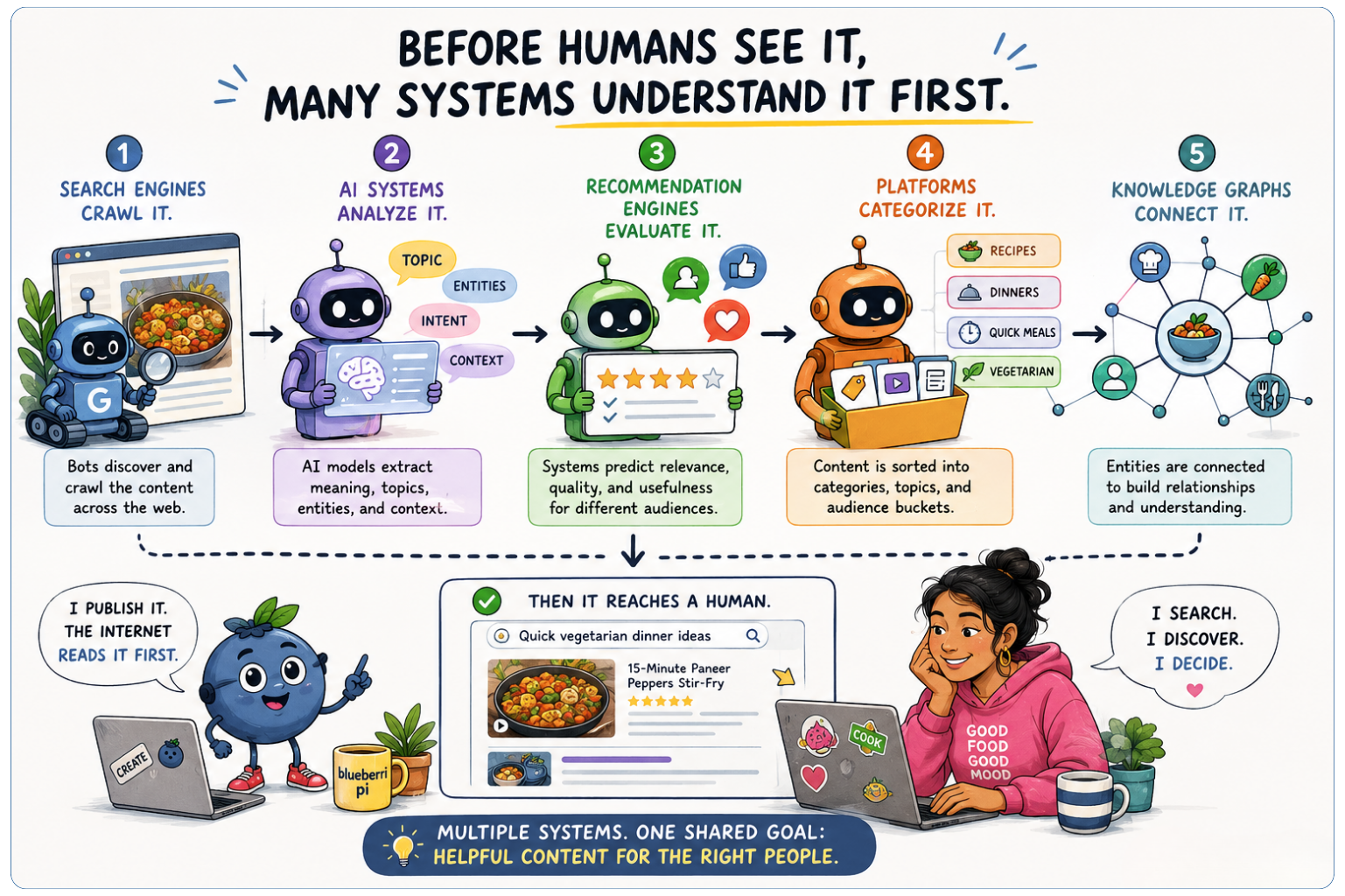
By the time a human sees a piece of content, several systems may have already processed it in different ways. Each system is attempting to determine what the content is about, who it might help, and whether it deserves visibility.
For creators like Nik, this can feel intimidating. It sometimes sounds as though success depends on understanding every algorithm, every platform, and every emerging technology. That’s an impossible standard because the systems themselves continue to change.
Don’t optimize for one platform or one AI tool. Create content that remains understandable, reusable, and useful no matter which system encounters it.
The mistake many creators make
When a new optimization trend appears, many creators immediately begin asking tactical questions.
Should I rewrite old posts?
Should I change my titles?
Should I restructure my content?
Should I learn a new framework?
Those questions are understandable, but they often focus on short-term adaptation rather than long-term value.
Nik notices this pattern in creator communities. Discussions quickly become dominated by tactics, checklists, and optimization tricks. Meanwhile, the more important conversation often gets overlooked.
The creators who survive multiple platform shifts rarely succeed because they mastered every tactic. Instead, they build durable assets that remained useful as technology evolved around them.
Durable content versus disposable content
Nik’s recipe for masala roasted potatoes may be discovered through Google today, YouTube tomorrow, and an AI assistant next year. The mechanism changes, but the usefulness remains. Someone searching for a reliable recipe still has the same need regardless of how they arrive.
This distinction matters because discoverability systems are temporary. Platforms change. Features come and go. Entire channels rise and fall. The internet is littered with examples of once-dominant platforms that now occupy only a small corner of digital history.
Useful content, however, often finds new paths to audiences. It adapts because its value isn’t dependent on a single discovery mechanism.
The question beneath every acronym
When viewed through this lens, GEO, AEO, SEO, and LLMO begin to look less like competing ideas and more like different attempts to answer the same question.
How does information move?
How does information get understood?
How does information reach the people who need it?
These are worthwhile questions. In fact, they’re becoming more important as content ecosystems become more complex.
Discoverability is not the goal. We’ve been programmed to think it is, but discoverability is a means to an end. The goal is to help someone solve a problem, learn something new, make a decision, or accomplish a task. The acronym may change. The purpose doesn’t.
Thinking beyond the platform
At some point, Nik stops worrying about which acronym will win. Instead, he starts asking a different question. What would make this content valuable five years from now?

Instead of optimizing exclusively for the platform, he begins thinking about usefulness. Instead of chasing every trend, he starts focusing on clarity, expertise, and structure. Instead of asking how content will perform this month, he considers how it might continue creating value in the future.
Ironically, this mindset often produces better results in the present as well. Content that is clear, trustworthy, and useful tends to perform well across multiple systems because it was designed around the audience rather than the algorithm.
Expand beyond discoverability
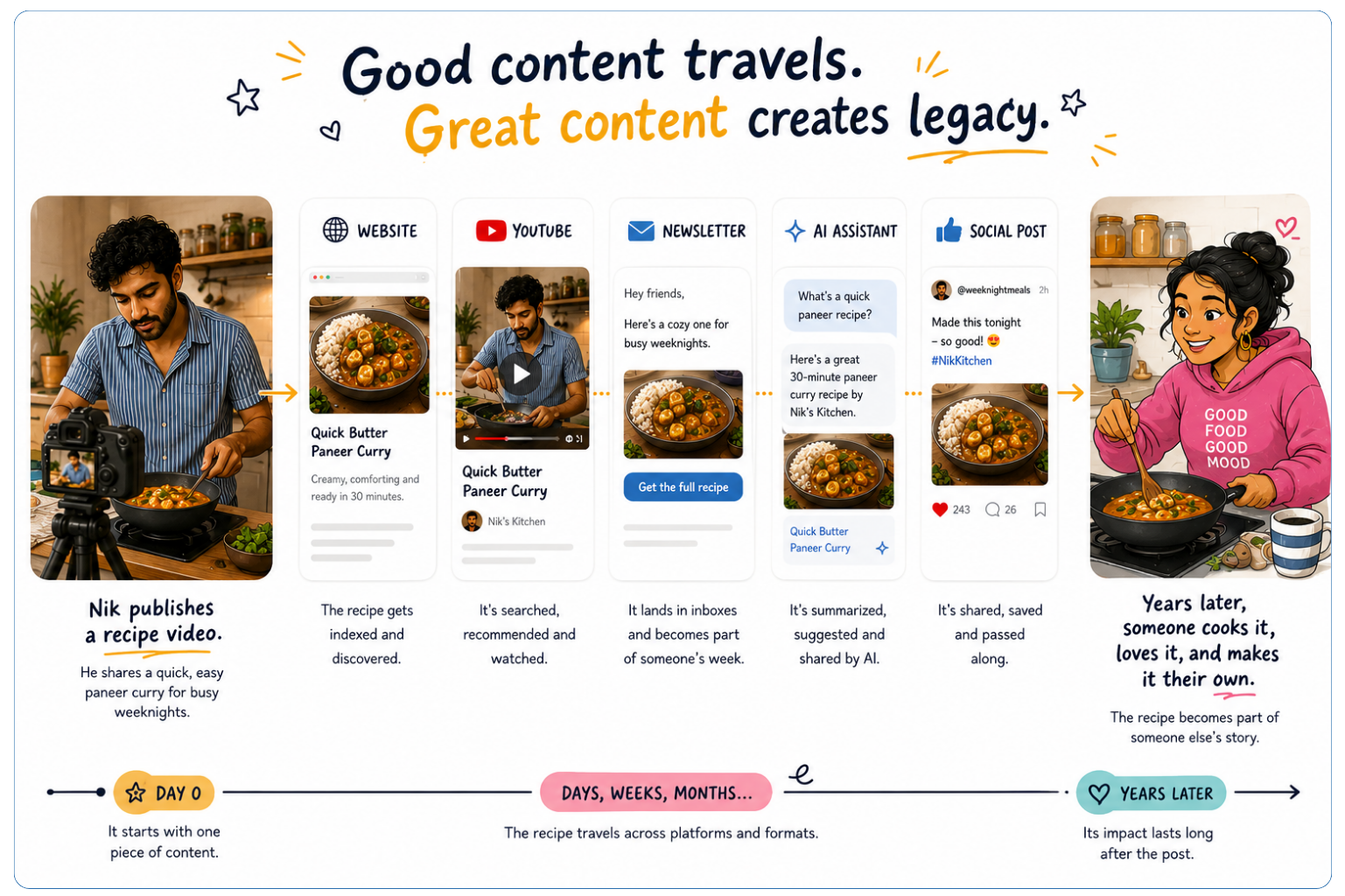
Content should be able to travel. It should move across platforms. It should adapt to different formats. It should remain useful in different contexts. Most importantly, it should continue creating value long after its original publication date.
This idea sits at the heart of the final stage of the COSE™ framework: Expand for Reach and Revenue.
The deeper purpose of Expand is longevity.
A recipe that helps someone today is useful. A recipe that continues to help people 10, 15, 20 years from now becomes more valuable. The same is true for articles, videos, frameworks, tutorials, and educational content. The most impactful content often extends beyond the moment it was created for.
Nik eventually realizes that this is the question he should have been asking all along. Not whether GEO will replace SEO. Not whether AEO is more important than LLMO. Not even whether his next video will perform well next week.
“Will this still be useful after the next platform update?”
When creators focus exclusively on discoverability, they risk optimizing for temporary systems. When they focus on expansion, they begin building assets that can survive those systems.
A great recipe can move from a blog to YouTube, from YouTube to an AI assistant, from an AI assistant to a newsletter recommendation, and eventually into someone’s family recipe collection.
The platform changes, and the value remains.
In that sense, Expand is not simply about reaching more people. It is about extending the life, usefulness, influence, and impact of content over time. It is about creating work that can outlast the algorithm, the trend and perhaps even the platform itself.
That’s why I think of Expand as a question of legacy.
Not what content performs best today. What content continues to matter tomorrow?
Who cares about the acronym
The history of the internet suggests that more acronyms are coming. There will be new platforms. New systems. New interfaces. New ways of discovering information. And inevitably, new labels designed to explain them.
Some will be valuable. Some will be forgotten. Most will represent attempts to make sense of a rapidly changing landscape.
The creators who thrive won’t necessarily be the ones who predict every trend. They’ll be the ones who understand that beneath every technological shift is a remarkably consistent human need. People are still looking for answers, ideas, inspiration, and expertise.
Honestly, who cares whether GEO replaces SEO? Why not focus more on what you are creating and if it will still matter after the next acronym arrives?
If you enjoy essays like this, subscribe to Blueberri Pi for weekly explorations of content systems, digital publishing, food media, and the future of content work.

Enjoying Blueberri Pi? Try an annual subscription. Annual members receive member-only resources, access to my exclusive podcast, deeper dives into industry shifts, and help support the independent research and writing behind every issue.
While acronyms come and go, thoughtful ideas are worth investing in.
What do you think?
Are GEO, AEO, and LLMO genuinely different disciplines, or are they different names for the same underlying challenge?
Leave a comment and join the conversation. I’d love to hear how you’re thinking about discoverability, AI, and the future of content.
The future of content work won’t be shaped by a single platform or the next trending tool. It’ll be shaped by the systems, ideas, and people willing to understand what’s changing beneath the surface.
If that sounds like the kind of conversation you want to be part of, you’re in the right place.
See you next Friday.
— Sandie
Good thoughts. This is helpful to not feel the whiplash of the next thing. I also think some tactics that meet the trends of the moment seem important too. So thinking about practical steps that meet the moment while keeping the consistent, non-reactionary longview in mind as you have suggested.