


I found a copy of Intelligent Content: A Primer at a thrift store this summer for $6.95. Water-stained cover, somebody’s old highlighter marks still in the margins, the kind of nerdy find that makes you stand in the aisle a little longer than you meant to.
I’ve had some time on my hands this summer, and instead of binging another cooking show, I decided to go time-traveling.
The Q4 Power-Up
Before we get into it, I’m running a limited-time Blueberri Pi Q4 Power-Up promotion through September 30.

Upgrade to an annual paid subscription, and you’ll lock in 20% off for as long as you stay subscribed, plus get a complimentary 1:1 strategy call with me, usually $150. Ask me anything about making your content work harder, monetizing what you’ve already created through partnerships and licensing, navigating AI and changing discovery, building better systems, growing beyond platform algorithms, proving your content's value, or figuring out what to prioritize next.
And there’s another reason to upgrade now. I have one of my favorite Blueberri Pi topics so far coming on October 16, exclusively for paid subscribers.
I’m not giving it away yet, but if you’ve been following my thinking on content, creators, and partnerships, you’ll want to have access to this one.
"You can't really know where you are going until you know where you have been." Maya Angelou
I’ve been deep in interviews as I’m writing my book this year, working title Create Once Share Everywhere, and one name keeps coming up whenever someone asks how the writing is going. Ann Rockley.
So I did what any reasonable person would do. I went back to the original source, starting with Intelligent Content: A Primer, which Rockley co-authored with Charles Cooper and Scott Abel.

The woman who saw it coming
The story, as it’s usually told, goes something like this. Long before “omnichannel” was a slide in every marketing deck, Ann Rockley was already looking at content and seeing something most people in the room weren’t seeing yet. It was the same piece of content, structured correctly once, could show up correctly everywhere it needed to. Web, print, mobile…whatever came next. That thinking eventually became part of what Rockley called intelligent content.
Rockley actually adopted the title "content strategist" back in 1989, and was working on content strategy, reuse, and structured content long before most organizations were talking about omnichannel delivery. Kristina Halvorson, author of Content Strategy for the Web, has called her “the mother of content strategy,” and in 2023 Rockley was inducted into the Content Strategy Hall of Fame for her foundational work in the field. By the time she was defining intelligent content for the tech comm world, she'd already spent years thinking about content as something designed to move, adapt, and be reused.
She describes intelligent content as “designed to be modular, structured, reusable, format-free, and semantically rich,” and the book adds that those qualities are what make content discoverable, reconfigurable, and adaptable in the first place.
But she was never on the marketing team. This was an engineering idea wearing a content strategist’s clothes, which is probably why it held up so well for so long.
What I actually learned building with this stuff
I worked deep inside a recipe platform’s content operations, watching a database grow well past 20,000 recipes while it fed a web app, an iOS app, an Android app, and eventually voice assistants and grocery retailer integrations with partners like Kroger and Target. Every one of those surfaces needed the same recipe to behave correctly, with the right ingredients mapped to the right products, the right substitutions, the right nutrition data, the right everything. And every surface had its own expectations for how that content needed to be shaped to work at all.
The mess was a modeling problem needing to be fixed. We’d been treating “ingredient” as a single field for years, when it was actually a small universe of relationships: name, quantity, unit, brand, substitution logic, allergen flags, retailer SKU. Once we modeled it properly, taxonomy did exactly what taxonomy is supposed to do. It let content move. Recipes that used to live and die on a single webpage started showing up in shopping lists, voice responses, and partner apps that didn’t even exist yet when the recipes were first written.
Taxonomy did what taxonomy is supposed to do. It let content move.
It felt novel then. Today, those kinds of connections are part of the grocery experiences people use every day. Turns out Ann Rockley already knew we’d be here. Years earlier, from a very different corner of the industry.
The building changed
The omnichannel era asked one question: can this content show up correctly on a new screen?
The current era is asking something harder. Can this content be understood, trusted, and used by a system that’s going to synthesize it into something else entirely, without a human ever clicking through to see it in its original form?
That’s a different bar. A recipe that displays beautifully on a phone can still be functionally illegible to an AI system trying to work out which step comes first, which ingredient is optional, and which line in your FAQ section is actually load-bearing versus which one is filler. Structured content got us onto more screens. It didn’t automatically get us ready to be reasoned about.
Then: Can this content show up correctly somewhere else?
Now: Can another system understand, trust, interpret, and use it correctly?
That’s the layer I keep coming back to with the food-tech platforms and content teams I talk to. The gap usually isn’t a lack of content, and it’s rarely a lack of effort either. It’s that the systems holding the content, the CMS, the taxonomy, the workflows connecting content to product, were built for a version of distribution that’s already one step behind where the traffic and the value are actually moving now. Producing more content on top of that gap doesn’t close it. It just adds more content that inherits the same structural problem.
Eventually, that stops being a content problem and becomes a business constraint. It’s the partnership your team can’t support without weeks of manual work, the product feature that takes months because the information it needs can’t be reliably retrieved, or the AI experience that misunderstands content your audience has trusted for years.
The risk isn’t that your content disappears. It’s that the opportunity moves somewhere your content can’t follow.
Structure is also a monetization strategy
Companies tend to separate content infrastructure from monetization. One lives in conversations about CMS migrations, metadata, taxonomy, APIs, governance, and content operations. The other lives in conversations about revenue. But they are much more connected than that.
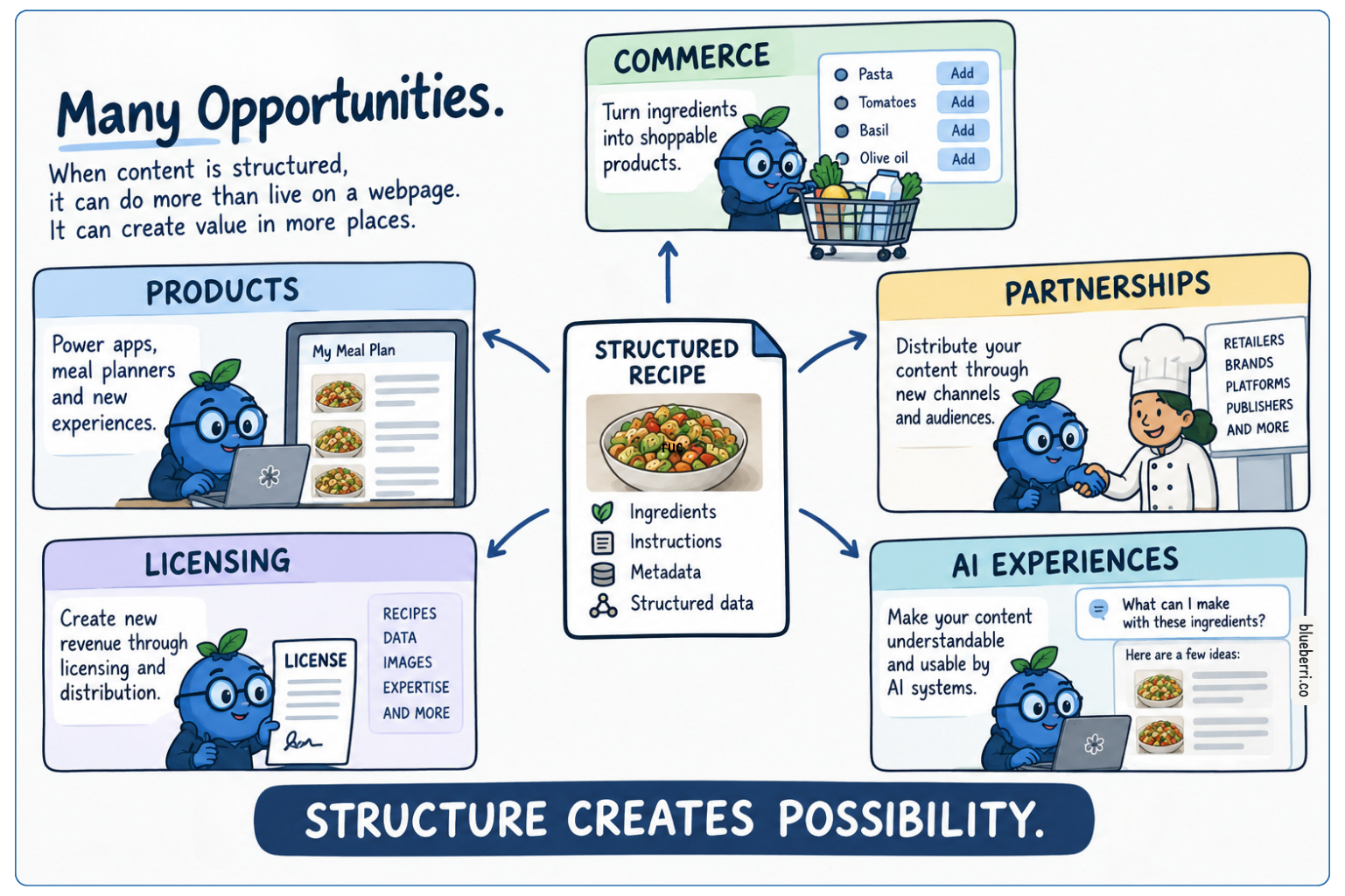
Think about that recipe again. As a webpage, its most obvious economic job might be attracting a visitor and generating advertising or affiliate revenue. Structure the underlying content, though, and suddenly the possibilities multiply. The ingredient can connect to commerce. The recipe can power a retailer integration. A collection of recipes can become a personalized meal-planning product. Nutrition and dietary attributes can support filtering and recommendations. A trusted archive can be licensed or distributed through partners. Structured expertise can support subscriptions, apps, APIs, AI experiences, or products that nobody had imagined when the original article was published.
Not every piece of content needs to do all of those things. That’s not the point. The point is that structure creates possibility, and that matters when nobody can confidently predict what the next important content surface will be.
A business sitting on 20,000 poorly structured recipes might technically own 20,000 pieces of content. A business that can reliably understand, retrieve, combine, govern, and distribute the information inside those recipes has something much more interesting: an adaptable content asset.
Content infrastructure has the potential to become revenue infrastructure. Metadata doesn’t magically make money, but structure lowers the cost of putting content to work somewhere new.
Still learning
I’m not here to tell you structured content is dead and something shinier replaced it. I’m here to tell you the opposite. The discipline Rockley helped build made content smart decades before anyone was asking AI systems to read it, and most organizations still haven’t fully finished the version they needed for the omnichannel era, let alone the one they need now.
Rockley's since stepped away from active content strategy work herself. These days she's doing health and career coaching instead. But the idea doesn't need her still in the room to hold up. The discipline she built is still running under everything I just described, whether or not she's the one consulting on it anymore.
The work in front of food-tech companies, recipe platforms, and content-rich teams can’t be a rebrand of content strategy. It’s the next chapter of it, one where your content has to work for readers, for product teams, for retail integrations, and for AI systems that are going to use your content whether or not you’ve prepared it to be used well.
That’s the throughline underneath everything I write here, and it’s a big part of what Create Once Share Everywhere is actually about. Content isn’t an asset until it’s structured, and structure is what decides whether your content can go where the opportunity actually is.
If your team is sitting on real content and real traction, but the systems underneath it are starting to strain, that’s a “structure what you have” problem, and it’s a lot more solvable than it feels like from the inside.
Rockley helped us figure out what smart content meant for the omnichannel world. Now we have to figure out what smart content means when the systems consuming it aren’t just displaying it, but interpreting it.
So am I. That’s most of why I bought the book.
Until next time,

P.S. The Q4 Power-Up ends September 30 — lock in 20% off your annual subscription + your complimentary 1:1 strategy call with me.
One of my favourite books! And the principles are so relevant.
I know I'm late to discovering this but glad I did