


I thought I was being responsible when I moved everything off my laptop and onto an external hard drive.
My laptop was running out of memory, and the drive had plenty of space—1TB. For years, this little Samsung drive was where I put everything I wanted to keep but didn’t need taking up space on my laptop. Business documents, old projects, photos, years of work. I even decorated it with little flower stickers, which somehow made my extremely questionable filing system feel more intentional. I called it a backup, which made the whole arrangement feel much more organized than it actually was.
But organized it was not. I didn’t have some great thought-out filing system. Most of the time, I plugged in the drive, moved over whatever was taking up space, and went back to work. There were folders inside folders, files with names that probably made perfect sense to me four years ago, and plenty of things I knew were in there somewhere. But they were there. That was what mattered.
Until one day, in the very recent past, they weren’t.
I plugged the drive into my laptop, and the little light came on, just like it always did. But this time, I couldn’t hear that familiar whirring sound, and the drive didn’t appear on my desktop. So I did what any reasonable person does when technology suddenly stops cooperating: I unplugged it and plugged it back in. IT expert hack.
Then I did it again. I changed the cable. Tried another port. Restarted my computer. Went through every small troubleshooting ritual that lets you convince yourself the next attempt is definitely going to be the one. The light kept coming on. The files never appeared. Eventually, after enough plugging, unplugging, cable swapping, and staring at my screen, my shoulders dropped.
I think I just lost everything.
Somewhere between panic and acceptance, the irony hit me. I spend a lot of time talking about content as an asset. About structure. About being able to find and reuse what you’ve already created. Yet I had taken years of my own work, dumped it onto a drive, and felt secure because technically, it was all there. I had confused storage with a system.
And we do the exact same thing with content all the time. We save it in a CMS, a Google Drive, an archive, a folder somewhere, and assume that because we kept it, we’ll be able to use it again. But stored and usable are not the same thing. If you can’t find something when you need it, it doesn’t really matter that you technically still have it.
You know the feeling. Someone asks a question in a meeting, a DM, or a comment section, and somewhere in the back of your mind, a little bell rings. We covered this. I know we covered this. Maybe it was a newsletter from two years ago. Maybe it was a webinar. Maybe it was a Slack thread that turned into a doc that turned into a post that turned into… you’re not sure where it went, actually.
So you do what everyone does. You dig for ten minutes, give up, and write it again.
Congratulations, you’ve just recreated content you already own.

The archive is not the asset
Content-heavy teams sometimes miss the real and urgent concept that having content in storage isn’t the asset they think it is.
An archive says: here is everything we’ve ever published.
A library says: here is what we know, how it’s organized, and how to find and use it.
Those are not the same thing, even though they can live in the exact same folder.
A creator with 1,000+ recipes. A publisher with a decade of interviews. A tech team with hundreds of webinars, FAQs, and how-tos scattered across a CMS, a Google Drive, a wiki nobody updates anymore, and at least one PDF someone emailed in 2019. All of that is content. Very little of it is currently an asset, because an asset is something you can find, understand, connect to other things, and put back to work on demand. Buried content doesn’t do that. It just sits there, technically existing.
Your content doesn’t become obsolete just because you stopped promoting it, but without structure, it can become practically unusable, which, from a business standpoint, is close enough to the same thing.
More content doesn’t fix this; it makes it worse
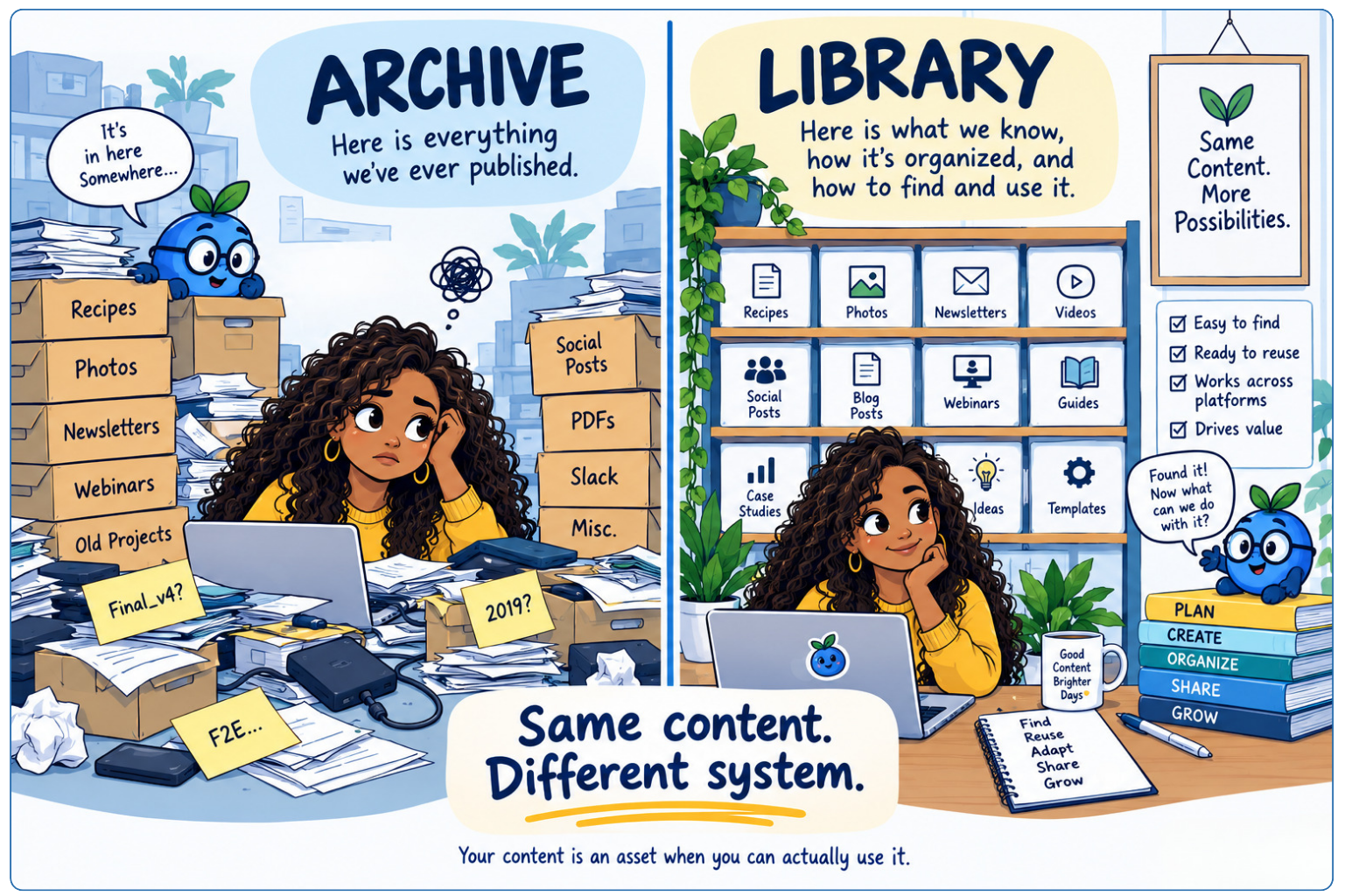
If your archive is disorganized, publishing more into it doesn’t help. It adds volume to a pile you already couldn’t search. We don’t talk about the messy truth behind a lot of “content velocity” conversations. But I like to talk about messiness. So here we are. Teams high-five themselves on shipping constantly, when what’s actually happening is closer to an organization that keeps recreating things it can no longer find, and calling the recreation “output.” The truth is, you can’t brainstorm your way out of a retrieval problem, you have to organize your way out of it.
What “organized” actually means here
.f you’re a creator and you’re still reading, this isn’t a taxonomy lecture, promise. But I do want to share a few concepts to do the heavy lifting:
Inventory — knowing what you actually have, not what you remember having.
Taxonomy — a consistent way of categorizing content so “find the recipe posts about slow cookers” is a query, not an archaeology dig.
Metadata — the descriptive layer that makes content searchable, filterable, and connectable, even when the content itself is buried three folders deep.
Relationships — knowing that this interview, that webinar, and this old FAQ are all talking about the same underlying idea, so they can be pulled together instead of rediscovered separately.
Reusable components — pieces of content (a stat, an explainer, a framework, a recipe base) that are structured to be pulled into new formats, not locked into the one they were first published in.
None of this is about being fancy. It’s about being able to answer, quickly and confidently: do we already have something for this?
Meet Sylvie

Let’s make this less abstract. Sylvie runs Gather & Green, a growing food brand she’s been building for years. She has recipes on her site, newsletters, social posts, videos, brand partnerships, photos, and plenty of ideas she knows she’s covered somewhere.
Fall is coming, and Sylvie wants to put together a weeknight dinner series. Her first instinct is to create. Except Sylvie already has a lot of what she needs. There’s a sheet-pan dinner from two years ago. Three recipes buried in different categories on her site. A newsletter about making weeknights easier. A brand partnership with a genuinely useful meal-prep tip. A video answering a question her audience still asks all the time. Individually, they look like old content. Organized, they start looking like a collection.
Sylvie can identify everything she has around weeknight dinners, see what’s missing, connect related pieces, and decide what can be reused as-is, what needs updating, and what actually needs to be created. Now the question isn’t What should I make? It’s What do I already have, and what can I do with it?
That’s a very different way to run a content business. Sylvie stopped treating creation as the automatic first step.
Reuse, don’t repeat.
Structure creates possibility
Content isn’t an asset until it’s structured, but once it is, it starts working differently. If you’re new here, this is the mantra I’ve been shouting from the soapbox I’ve been on. You will read and hear this in every context I can share it.
An organized library isn’t just easier to search. It’s easier to repurpose into new channels, easier to license or package into a product, easier to hand to a partner without a three-week content audit first, and easier to pull revenue out of, because you can actually see what you’re sitting on.
This is the part of my COSE™ framework that people skip past too fast. Create Once, Share Everywhere sounds like it’s about distribution. It isn’t, not really. It’s about reuse. And reuse only works if you can find what you created in the first place. A brilliant piece of content nobody can locate is not being shared everywhere. It’s being shared nowhere, slowly, forever.

Reuse, don’t repeat.
Content should work harder than the people creating it. That only happens when it’s organized well enough to be found by the people who need it, including, frequently, the very team that made it.
What’s actually at stake
If you don’t figure this out, the problem just gets bigger.
You pay to recreate what you already own. Every “let’s just write a new one” is hours (or a freelancer invoice) spent duplicating an asset that already existed, somewhere, unfindable.
Internal domain expertise walks out the door. When the only index of what your team knows is a person’s memory of “I think we covered that in a webinar once,” you lose the archive every time that person leaves.
You can’t sell what you can’t see. Licensing deals, partnerships, API products, premium bundles — all of it depends on being able to say precisely what you have. “Somewhere in there” is not a pitch.
New channels stay closed. AI search, aggregators, partner integrations — the systems increasingly deciding what gets surfaced and reused all reward structure. Unstructured content isn’t just hard for you to find. It’s hard for anything else to find, too.
The team slows down, even while looking busy. Velocity measured in output can mask a real decline in the amount of new thinking happening, because so much of the work is rediscovery in disguise.
None of this shows up on a dashboard labeled “disorganized archive.” It shows up as slower launches, duplicated effort, missed revenue, and a nagging sense that the team should have more to show for years of work than it does.
How I learned this
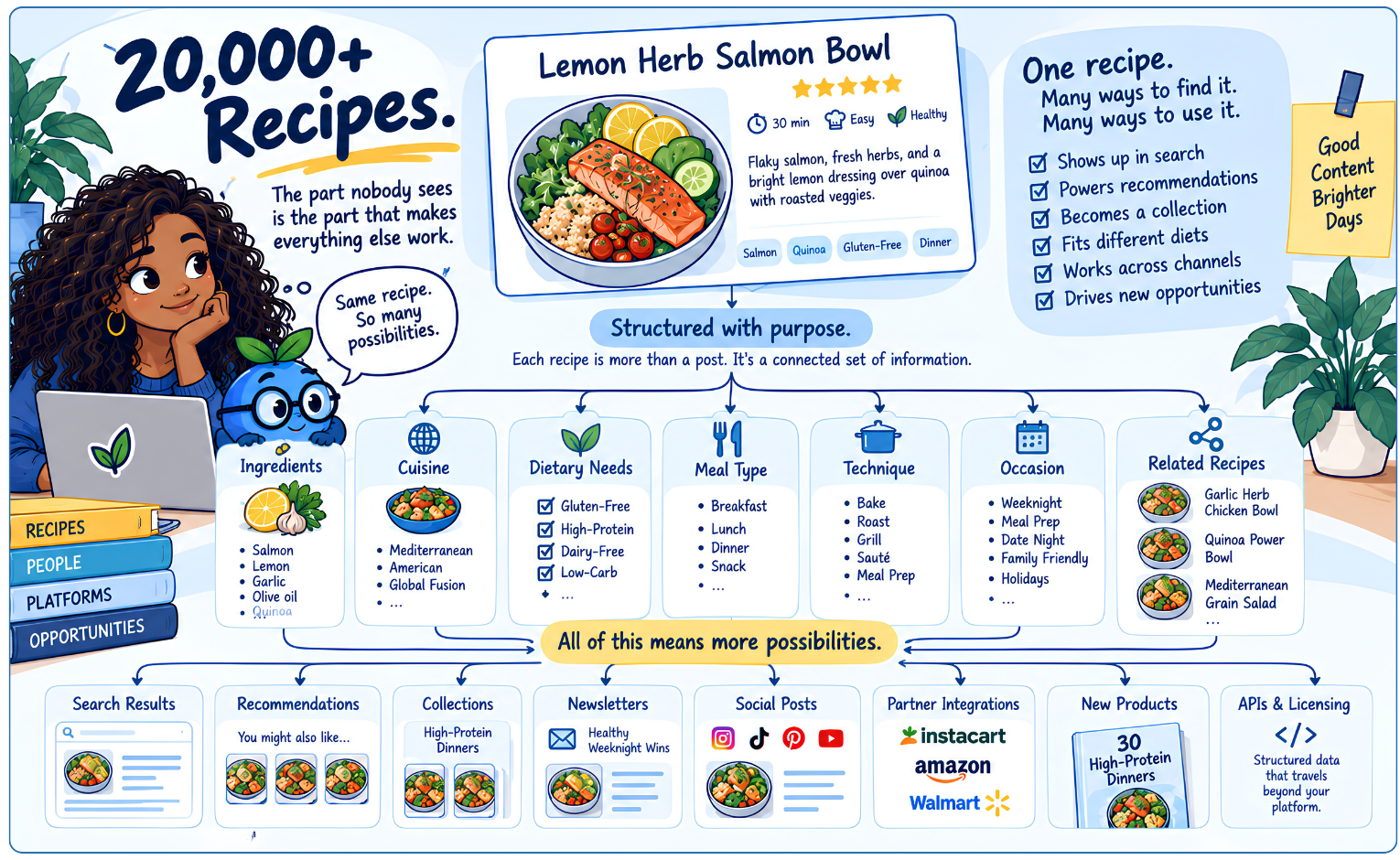
When I was at SideChef, I wasn’t managing a blog, but I was responsible for the taxonomy, metadata, and ingredient systems underneath a recipe database that large. And the lesson that stuck with me wasn’t about recipes at all. It was that at that scale, “we have the content” and “we can use the content” are two completely different things. A recipe that existed but couldn’t be reliably categorized, filtered, or connected to related recipes wasn’t really an asset yet, it was raw material sitting one bad search query away from being invisible.
Building the structure underneath that library, the categories, the relationships, the metadata that let a single recipe surface correctly across dozens of contexts, is what made the difference between a pile of content and something the business could actually build on. That’s the part nobody sees in the finished product. It’s also the part that determines whether everything else works.
I’ve never stopped noticing that same gap since — in newsletters, in webinar libraries, in a decade of interviews sitting in someone’s Drive. The content is rarely the problem, but what’s underneath it, or isn’t, usually is.
Reframe your process
Before the next planning cycle, before the next content calendar gets built, before anyone assigns “refresh old content” as a task, figure out what you already have.
What are you already sitting on that you still haven’t learned how to use?
You are probably sitting on more value than your content calendar gives you credit for.
Until next time,
